Our partners








.png)


Spike in mineral fertilizer costs since 2022, compressing farm margins across the EU
Price gap between EU-grown and imported cereals (2024), undercutting local competitiveness
Of EU cropland flagged for drought risk during the 2025 growing season
EU-mandated reductions in fertilizer and pesticide use by 2030 (Farm to Fork)
Biological fertilizers have a credibility problem — not because the science is wrong, but because delivery is broken.
Survival Failure
of applied bacteria survive in real soil. Without protection, cells die from UV, desiccation, temperature, and competition from native microflora before reaching roots.
Application Incompatibility
Most biological products can't be mixed with fungicide-treated seeds or tank-mixed with crop protection. Extra passes, extra cost, extra friction for the farmer.
Shelf Life & Logistics
Typical viability window for unprotected biologicals. Many require cold-chain storage. By the time product reaches the farmer, a significant portion of bacteria may be dead.
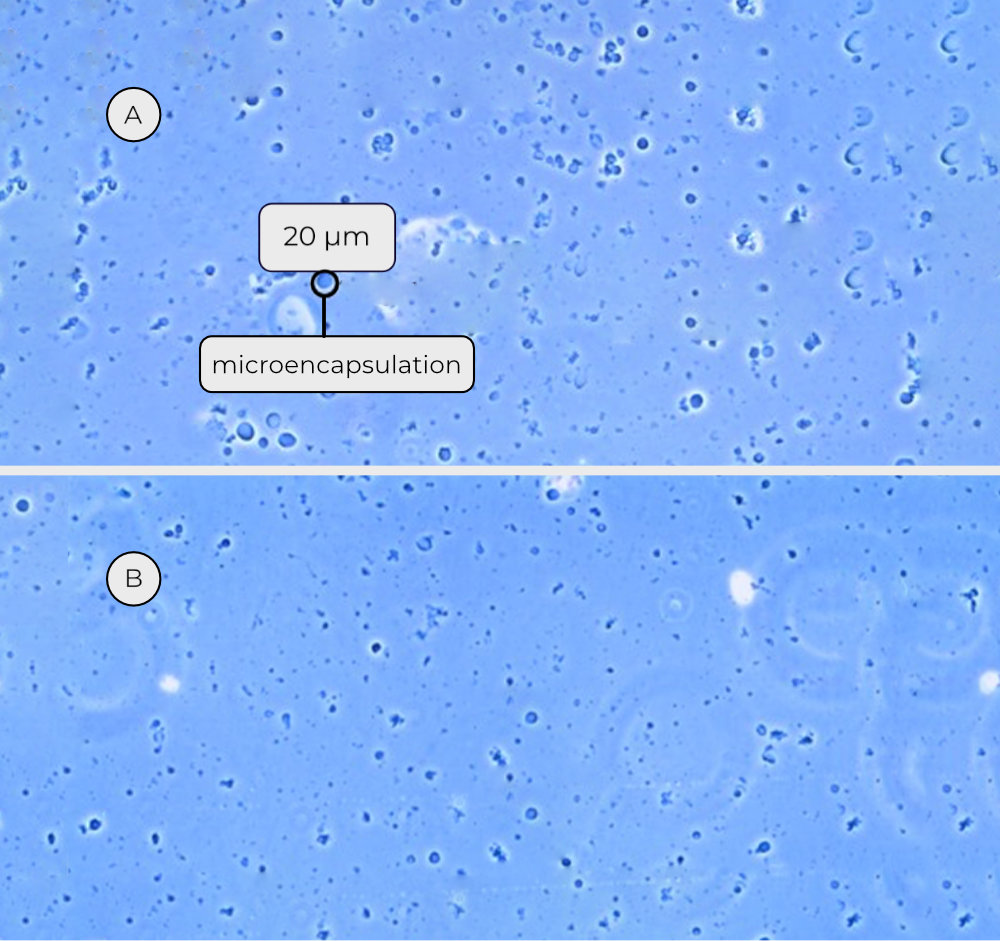
Labelled: ≥10⁹ CFU/mL
CFU/mL measured.That's a ~3,000× shortfall between label claim and actual viable count.
Expected: clean dominant Bacillus profile
Non-uniform growth behaviour and microscopy signals inconsistent with a clean dominant Bacillus profile. Composition and viability not reliably delivered — repeatability breaks even if the farmer follows the label exactly.
We put a protective biopolymer shell around live bacteria. This isn't a coating — it's a controlled microenvironment that keeps cells alive during storage and delivers them precisely where plants need them.
Higher Survival
Encapsulated bacteria showed five times higher survival vs. non-encapsulated under stress conditions (V1 lab validation). The protective biopolymer matrix shields cells from UV, temperature, desiccation, and microbial competition.
Farm-Ready Powder
Enthela Microencapsulation V2 produces a dry, free-flowing powder compatible with standard seed-treating equipment and spray nozzles. Application: just 50–100 g/ha. No new hardware, no cold chain.
12+ Month Shelf Life
V1 extrusion capsules maintained viability for up to 2 years in dried form. V2 targets 12+ months at room temperature. No cold chain. Store and transport like any conventional dry input.
Each microcapsule (~10–20 µm) contains selected bacteria from a 100+ strain collection inside a cross-linked biopolymer shell. The capsule protects from external stress factors during storage, application, and early soil exposure — then releases bacteria gradually through moisture and root exudate triggers.

~10–20 µm capsule size
Structural integrity >2 weeks
Seed Treatment
Apply directly to seeds — even pre-treated with fungicides. The biopolymer shell protects bacteria from chemical contact during storage and sowing.
Soil Spraying
Powder disperses in water, passes through standard spray nozzles (<100 µm). No clogging, no settling, compatible with tank mixes.
Ultra-Low Dose
50–100 g/ha vs. 600–700 kg/ha for conventional fertilizer. 1/1,000th the mass. One bag treats an entire field.
Product V1 — Enhanced Extrusion
Using ionotropic gelation (extrusion into CaCl₂), we created alginate capsules (~3 mm) containing Azotobacter vinelandii. This proved the core thesis:
5×
higher survival vs. non-encapsulated under stress
2+ yr
shelf life in dried form
Product V2 — Enthela Microencapsulation V2
Pivoted to spray-drying to achieve industrial scalability. One-step microencapsulation and drying produces ~10–20 µm powder capsules.
10–20 µm
higher survival vs. non-encapsulated under stress
≤1 log
viability loss during process*
*0.5–1.0 log₁₀ loss vs. multi-log (>99%) loss typical of unprotected cells. Verify exact % with latest batch data.
Conducted with Enthela V1 (enhanced extrusion) in collaboration with Sofia University. RCBD, 7 treatments + control, 30 plants/treatment/block. Aim: prove that capsule protection keeps more microbes alive, resulting in more effective plant performance vs. free-cell delivery (the current market approach).
Treatment
Rel. Yield %
vs. Control
vs. Control
100% Mineral N (control)
100%
baseline
632.6
75% N only
(no bacteria)
95%
−5%
—
75% N + Free Cells
(market approach)
98%
−2%
—
75% N + Encapsulated
115%
+15%
—
50% N + Encapsulated
~104%
+4%
659.5
Encapsulation outperformed free cells by up to 2.4 t/ha (+15%)
At 75% N, free cells reached only 98% of control — the encapsulated form reached 115%. At 50% N, encapsulated bacteria produced more kernels per ear (659.5) than the full 100% N control (632.6). 1000-kernel weight: 481g vs 428g control (+12.6%). The 15–20 percentage-point advantage directly underpins the target of ≥15% nutrient-use efficiency improvement.
Where We Are

